Practical, evidence-informed steps for before, during and after your flight.
Last updated: September 2026

Jet lag happens when rapid travel across time zones leaves your internal body clock out of sync with the local time at your destination. It can affect sleep, alertness, concentration, digestion, mood and physical performance.
There is no single method that instantly resets your body clock. The most effective approach combines preparation, correctly timed light, sleep and meals on destination time, movement, hydration and support for common jet lag symptoms.
Jet lag: the quick answer
-
Before flying: Start well rested and gradually move your sleep schedule towards your destination time.
-
During the flight: Follow destination time where practical, drink water regularly, move around and limit alcohol.
-
After arrival: Use daylight strategically, eat and sleep on local time and keep daytime naps brief.
-
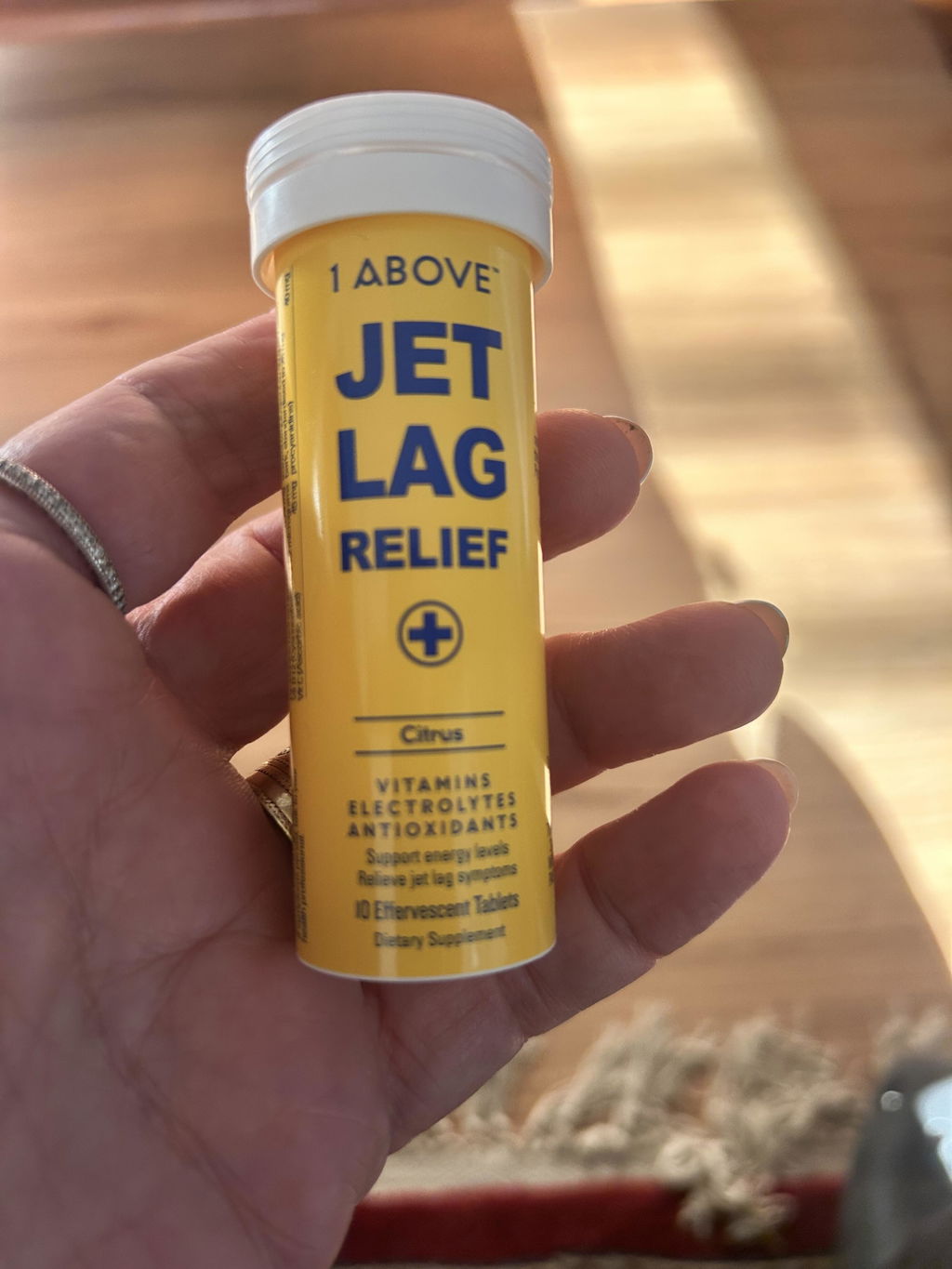
For symptom support: Use 1Above Jet Lag Relief+ as directed before, during and after travel to help relieve jet lag symptoms and support energy and hydration.
Important: Hydration and travel nutrition can support how you feel, but they do not by themselves reset your circadian rhythm. Light exposure and sleep timing remain central to adjusting your body clock.
What is jet lag?
Your circadian rhythm is the roughly 24-hour system that helps regulate when you feel awake, sleepy and hungry, as well as changes in hormones and body temperature. After rapid travel across several time zones, that internal schedule can remain aligned with your departure point while the destination is operating on a different clock.
The US Centers for Disease Control and Prevention says jet lag usually occurs after travelling across more than three time zones, although anyone crossing multiple time zones can be affected.
Common symptoms include:
- Difficulty falling asleep or waking at the desired local time
- Daytime tiredness or difficulty staying alert
- Poor-quality sleep
- Reduced concentration, memory or mental sharpness
- Changes in appetite or digestion
- Mild changes in mood
Jet lag vs travel fatigue
Jet lag and travel fatigue often occur together, but they are not the same thing. Understanding the difference makes it easier to choose the right strategy.
|
Jet lag |
Travel fatigue |
| Main cause |
Your body clock is misaligned with the destination time zone. |
The physical and mental demands of a long journey, including disrupted sleep, prolonged sitting, changing routines and a dry cabin environment. |
| When it happens |
After travelling rapidly across multiple time zones. |
After any demanding journey, even without crossing time zones. |
| Typical clues |
Feeling sleepy or awake at the wrong local times, disrupted sleep and difficulty adjusting to the destination schedule. |
General tiredness, stiffness, dryness and reduced energy after travelling. |
| What helps most |
Correctly timed light, sleep and meals aligned with local time. |
Rest, water, regular movement, comfortable sleep and normal meals. |
How long does jet lag last?
There is no reliable recovery timetable based only on the number of time zones crossed. Symptoms often improve within a few days, but they can last longer after larger time-zone changes or when travel also causes substantial sleep loss.
Recovery varies according to:
- The number of time zones crossed
- Whether you travel east or west
- Your sleep before and during the journey
- The timing of light exposure after arrival
- Your individual circadian rhythm and travel schedule
The familiar rule of approximately one day per time zone is only a rough guide, not a prediction for an individual traveller. If you need to perform well at an important meeting, competition or event, the CDC suggests arriving at least two days beforehand where possible.
Why eastbound and westbound travel are different
Eastbound travel usually requires your body clock to move earlier. Westbound travel usually requires it to move later. Most people find it easier to delay their body clock than to advance it, which is why eastbound trips can feel harder.
Light is one of the strongest signals for shifting the body clock, but timing matters:
-
After eastbound travel: Appropriately timed morning light generally helps move the body clock earlier.
-
After westbound travel: Appropriately timed late-afternoon or evening light generally helps move the body clock later.
More light is not always better. After large time-zone shifts, light at the wrong time can move the body clock in the wrong direction. The detailed timing also depends on your route, arrival time and usual sleep schedule. For complex or high-stakes travel, use a personalised light-timing plan or seek advice from a sleep or travel-health professional.
Your 3-step jet lag plan
Step 1: Before your flight
-
Start rested. Avoid beginning a long journey with accumulated sleep loss.
-
Shift gradually. For two or three days before departure, move bedtime and wake time earlier for eastbound travel or later for westbound travel.
-
Plan your light. Adjust indoor and outdoor light exposure alongside your sleep schedule rather than relying on sleep changes alone.
-
Leave a buffer. Where possible, arrive at least two days before an important commitment.
-
Begin 1Above Jet Lag Relief+. For best results, take two tablets daily for two to three days before departure.
Step 2: During your flight
-
Switch to destination time. Change your clock after boarding and use the destination schedule to guide sleep and meals where practical.
-
Sleep strategically. Try to sleep when it is night at your destination. An eye mask, earplugs and a comfortable temperature may help.
-
Drink water regularly. The dry cabin environment can make your mouth, nose and skin feel dry. Limit alcohol, which can disrupt sleep.
-
Use caffeine carefully. It may support alertness during the destination daytime, but avoid it close to the sleep period you are trying to establish.
-
Choose lighter meals. Smaller meals may be easier on digestion, particularly when meal timing changes.
-
Move periodically. Stand, walk and stretch when it is safe to do so.
-
Take 1Above as directed. Dissolve one tablet in 500 mL of water every two to three hours while awake during the flight. Do not take more than seven tablets in 24 hours.
Step 3: After arrival
-
Follow local time. Eat, sleep and wake according to the destination schedule as soon as practical.
-
Use daylight strategically. Base the timing on your travel direction and the size of the time-zone change.
-
Keep naps brief. If daytime sleepiness is difficult, a short nap of around 15 to 20 minutes may help without making local bedtime harder.
-
Move and eat normally. Gentle exercise and meals on local time can reinforce the new daily routine.
-
Continue 1Above. Take two tablets daily for two to three days after arrival to support recovery.
Calculate how much 1Above you need for your journey
What supplements help with jet lag?
No supplement replaces correctly timed light and sleep. Supplements may support specific parts of the travel experience, but they should be considered alongside the wider circadian strategy.
-
Electrolytes: Help maintain electrolyte balance and support hydration.
-
Vitamins: Certain vitamins support normal energy metabolism.
-
Antioxidants: Help reduce free radicals formed in the body.
-
Melatonin: May support sleep or circadian timing when used correctly, but recommendations and availability vary by country. Timing is important, and melatonin may cause side effects or interact with medicines. Seek professional advice before use.
Where 1Above Jet Lag Relief+ fits
1Above Jet Lag Relief+ is a melatonin-free effervescent formula containing Pycnogenol®, vitamins and electrolytes. It is designed to help relieve jet lag symptoms and support energy and hydration.
1Above should be used alongside correctly timed light, sleep and meals. It supports common symptoms and the demands of travel; it does not independently reset your body clock.
What does the research say about Pycnogenol® and jet lag?
A 2008 preliminary report evaluated Pycnogenol® at 50 mg three times daily for seven days, beginning two days before flying and continuing during and after travel. The authors reported improvements in several jet lag symptoms.
This research was preliminary and studied a specific ingredient regimen. It did not test the finished 1Above formula, so it should not be treated as direct clinical proof of the complete product. Each 1Above tablet contains 40 mg of Pycnogenol® and should be taken according to the product directions.
Explore 1Above Jet Lag Relief+
Frequently asked questions
Can jet lag be completely prevented?
Not always. No routine can guarantee that you will avoid every symptom, but preparation, appropriately timed light, destination-aligned sleep, hydration and movement can reduce the impact.
How long does jet lag usually last?
Jet lag often improves within a few days, although larger time-zone shifts, eastbound travel and substantial sleep loss can extend recovery. A fixed recovery table cannot accurately predict an individual traveller's experience.
Is eastbound jet lag worse than westbound jet lag?
It often is. Eastbound travel generally requires the body clock to move earlier, which is harder for most people than moving it later. Individual responses and routes still vary.
Does drinking water stop jet lag?
No. Water supports hydration and can help with the discomfort of a dry cabin, but it does not reset the circadian rhythm. It should be one part of a wider strategy involving light and sleep timing.
What is the difference between jet lag and travel fatigue?
Jet lag is caused by a mismatch between your body clock and the destination time zone. Travel fatigue comes from the physical and mental demands of the journey and can happen even when no time zones are crossed.
When should I take 1Above for travel?
For best results, take two tablets daily for two to three days before departure. During the flight, dissolve one tablet in 500 mL of water every two to three hours while awake, with a maximum of seven tablets in 24 hours. Continue with two tablets daily for two to three days after arrival.
Does 1Above contain melatonin?
No. 1Above Jet Lag Relief+ is melatonin-free. It contains Pycnogenol®, vitamins and electrolytes to help relieve jet lag symptoms and support energy and hydration.
Should I adjust fully for a short trip?
Not necessarily. For a trip lasting only two or three days, maintaining a schedule closer to your home time may sometimes be more practical, particularly if your commitments allow it. Consider the direction of travel, meeting times and how quickly you need to readjust after returning home.
Quick jet lag checklist
- Begin the journey well rested
- Shift sleep earlier before eastbound travel and later before westbound travel
- Plan light exposure instead of relying on blanket morning-light advice
- Follow destination sleep and meal times during the flight where practical
- Drink water regularly and limit alcohol
- Use caffeine strategically and avoid it near planned sleep
- Move and stretch during long flights
- Keep daytime naps short after arrival
- Use 1Above Jet Lag Relief+ according to the label directions
Sources and further reading
- Centers for Disease Control and Prevention: Jet Lag
- Mayo Clinic: Jet lag disorder - Diagnosis and treatment
- NHS: Jet lag
- Belcaro G, et al. Jet-lag: prevention with Pycnogenol. Preliminary report. Minerva Cardioangiologica. 2008.
How this guide was prepared: This guide was created by 1Above, the maker of 1Above Jet Lag Relief+. It draws on guidance from independent health authorities and published research referenced below. Product directions are based on the approved 1Above label. Research relating to individual ingredients is identified separately and should not be treated as clinical evidence for the finished 1Above formula.
Important information: This guide provides general information and is not medical advice. Always read the label and follow the directions for use.